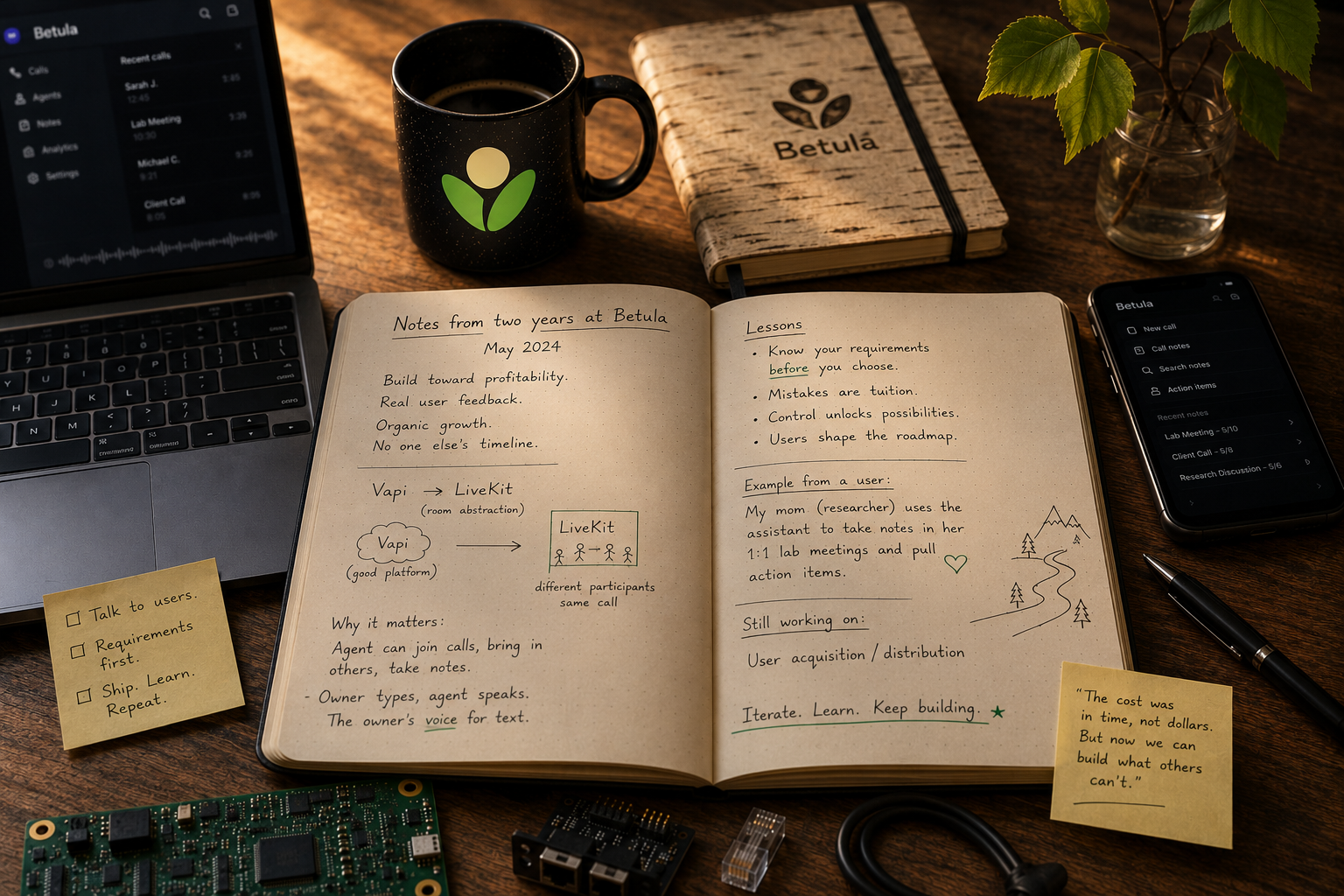
I founded Betula in May 2024, with my father serving as advisor and angel investor. It's my first startup, and the learning curve has been steep. I'm logging my experiences here in case any of them prove useful to other founders.
Bootstrapping has been the right call
One of our earliest decisions was to build toward profitability without raising outside capital. So far, it's been our best decision. It's let us shape the product around real user feedback and grow organically, without the pressure of someone else's timeline.
The voice platform we picked first was wrong
Our initial technical choice didn't hold up. We started on Vapi and eventually migrated to LiveKit — one that's more robust, scalable, and cost-effective, and, most importantly, flexible enough to let us build features that would otherwise be impossible.
To be clear, Vapi is an excellent platform for building voice agents. The mismatch was on our side: we needed full control of the stack down to the telephony layer (SIP), and Vapi is deliberately designed to abstract that lower layer away — for good reasons. It just wasn't the right fit for what we wanted to build.
A concrete example of what that control buys us: LiveKit's room abstraction lets different kinds of participants join a call. We use it so our agent can sit in on calls, pull in additional participants, and take notes. It also lets the owner interact with a caller by text while the agent speaks to them by voice — useful when a professional gets a call mid-meeting and wants to respond quickly. The agent becomes the owner's voice for the text they're typing.
In hindsight, the mistake wasn't picking Vapi — it was not knowing our own requirements well enough to pick the right platform the first time. The migration cost us more in time than in dollars, but it was worth it. We can now offer functionality that's nearly impossible to ship on most off-the-shelf voice platforms. The trade-off is that we own a lot more of the underlying plumbing, which we're comfortable with.
Who we're building for
Betula's target customers are early adopters and small business owners — especially "one-person show" operators. Healthcare partnerships are an exception to our main focus; most of our product refinements still come from individual users.
A good example: the feature that lets the agent listen in on a phone call and take notes came directly from customer requests. One of those users is my mom, a researcher, who now uses her assistant to take notes during her one-on-one lab meetings and pull out action items.
What we haven't solved yet
Scaling user acquisition. Listings in directories have helped, but growth beyond our early adopters and friends-and-family base is still an open problem.
We're not in a rush, though. We'd rather keep iterating with our existing users and make sure the product genuinely adds value — while figuring out distribution.
Thanks to Claude for editorial support on this post.