Built for Real-World Use Cases
Our technology is designed to solve the challenges that arise when AI leaves the demo environment and starts interacting with real people over the phone.
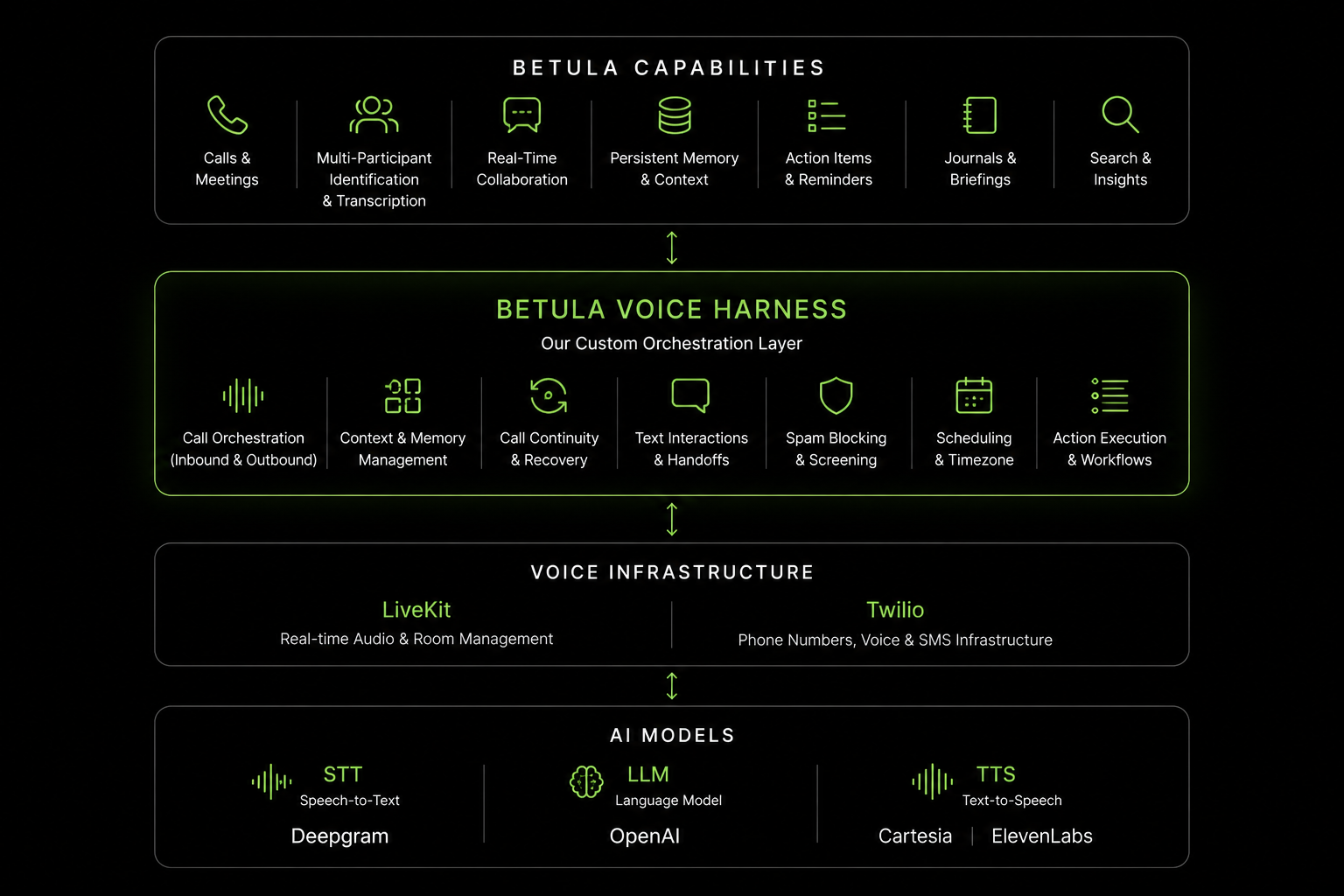
- minimizing conversation and action latency
- handling carrier-grade call routing and spam blocking
- recovering seamlessly from dropped calls
- orchestrating outbound calls, texts, and reminders
- enabling real-time owner collaboration during calls
- maintaining persistent memory across interactions
- interacting with legacy phone systems via DTMF
- ensuring accurate timezone-aware scheduling
- producing natural speech for numbers and phone calls
- safeguarding caller privacy and data
Custom Harness for Voice Assistants
We built a purpose-built harness (on top of LiveKit) tailored for voice assistants—not a generic conversational framework repurposed for speech. Our stack provides:
- ensuring reliable orchestration of inbound and outbound calls
- maintaining persistent, searchable call history, transcripts, action items, reminders, and journal entries
- ensuring consistent memory and context across calls and text interactions
- decoupling speech and language models from application logic
- continuously testing and monitoring for production reliability
Things other platforms abstract away, we built from scratch. Every layer—from carrier interconnects to LLM orchestration—is ours to inspect, tune, and control.