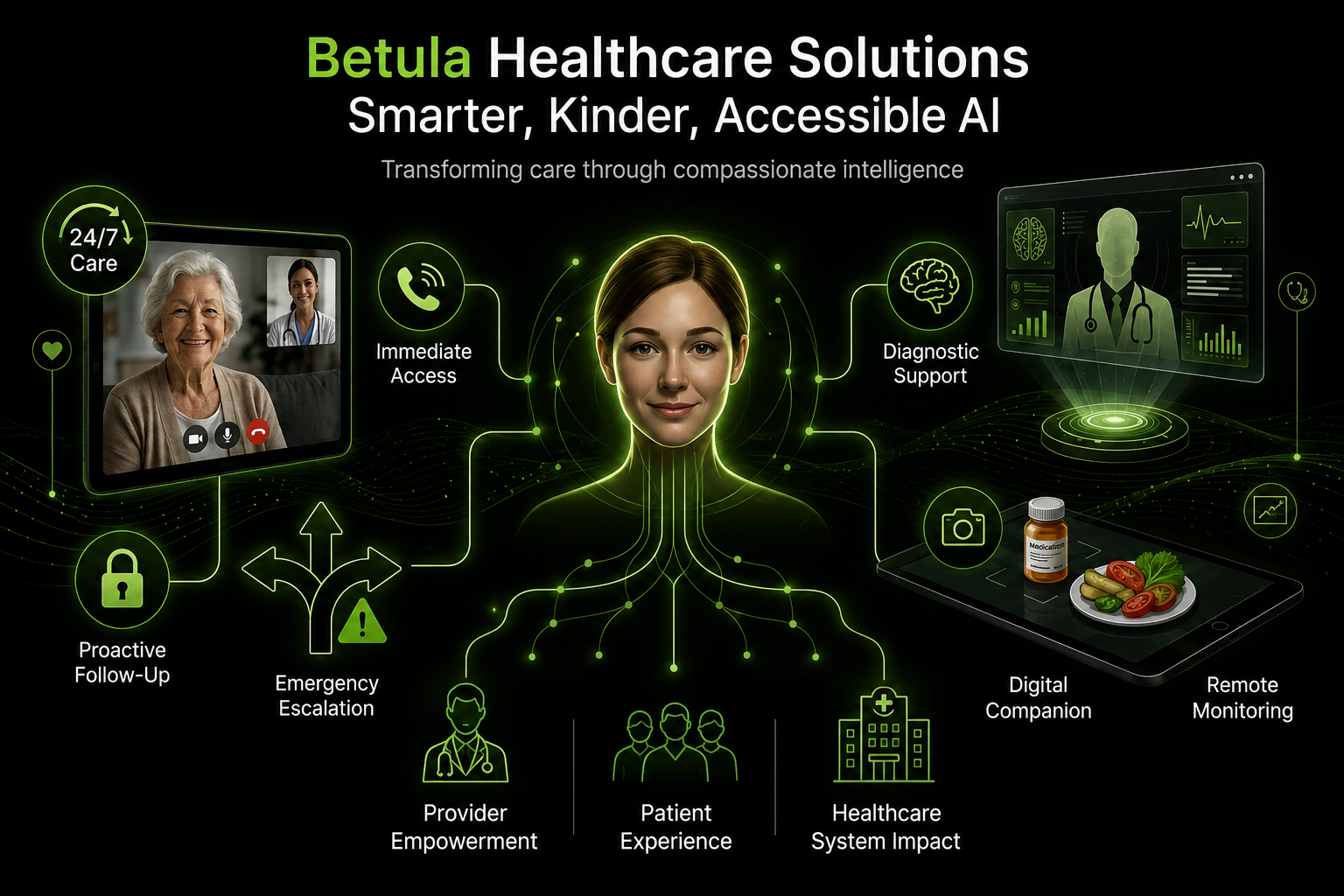
Our Objective
To champion care that's smarter, kinder, and accessible to all. We build multi-agent AI systems that don't just automate tasks—they transform how healthcare providers connect with patients, making quality care available 24/7 regardless of location or resources.
Our Story
We are a small, dedicated team committed to leveraging state-of-the-art AI technology to make healthcare accessible to everyone. We believe that quality care shouldn't depend on location, resources, or time of day—and we're building the technology to make that vision real.
The Healthcare Challenge We're Solving
The Problem:
Healthcare providers face an impossible tradeoff: maintain quality patient interactions while managing increasing call volumes, after-hours needs, and administrative burden. The result? Missed calls, delayed responses and follow-ups, provider burnout, and patients who can't access care when they need it most.
Our Collaborative Approach:
We partner with healthcare solution providers - to build specialized multi-agent AI systems on top of our Betula AgentStack. Whether you're focused on specific clinical workflows, patient populations, or care delivery models, we collaborate to create solutions that fit your vision and your patients' needs.
Our partnership model turns concepts into deployed solutions—market-ready products that improve care delivery and create measurable value for patients, providers, and healthcare systems.
Our partnership with sai-connect.org, a non-profit organization, holds special significance. Through sai-connect, we are realizing our objective of making healthcare accessible to all—bringing compassionate AI-powered care to underserved communities and populations who need it most.
How our technology truly serves people
Patient Experience Transformation
- Immediate access to care - First-ring pickup, zero hold times, 24/7 availability
- Privacy-first design - HIPAA-compliant infrastructure protecting sensitive health information
- Natural conversation - Patients can ask questions anytime without disrupting the flow
- Continuity of care - Intelligent call recovery if connections drop
- Multilingual support - Breaking language barriers to healthcare access
- Compassionate interaction - AI that listens, adapts, and escalates appropriately
Provider Empowerment
- 40-60% reduction in administrative call burden
- Comprehensive documentation - Every patient interaction captured accurately
- Preliminary diagnostic support - Differential diagnosis for physician preview
- Emergency detection - Real-time identification and escalation of urgent conditions
- More time for what matters - Providers focus on clinical judgment, not phone calls
Healthcare System Impact
- Scalable without staffing - 24/7 coverage without hiring night shifts
- Consistent quality - Every patient gets protocol-adherent care
- Accessible care - Reaching remote corners and underserved populations
- Measurable outcomes - 3-5 minute reduction per intake, 98%+ call recovery success
Production-Ready AI with State-of-the-Art Models
The technology powering human-like AI agents is advancing at an unprecedented pace. Voice agents that are not only expressive in their speech tones, but can pick up on emotions conveyed in a patient's voice, avatars with visual presence that convey warmth and empathy, perception models that can see and interpret the world like humans—these capabilities are evolving from research prototypes to production-ready systems in months, not years.
Betula stays at the forefront of this acceleration. We continuously evaluate emerging technologies across voice synthesis, conversational AI, computer vision, and multimodal interaction. When these technologies mature and demonstrate real-world reliability, we rapidly integrate them into our production agents—ensuring our healthcare partners benefit from the latest advances in making AI feel more natural, accessible, and human.
For instance, today's predominant production solution for voice agents uses a three-model architecture: speech-to-text, language model, and text-to-speech. While emerging single-model speech-to-speech solutions are inherently superior—preserving speaker tone and emotional nuance that's lost in text conversion—their tool-calling performance hasn't yet reached production quality levels. However, new speech-to-speech models are being released with steadily improving capabilities. We actively monitor this progress, ready to adopt them the moment they match the reliability and tool-calling performance our healthcare applications demand.
Showcased on this page are agents leveraging LiveKit—the most scalable platform to build real-time multi-modal agents, Hedra that gives agents a visual presence, and Tavus for perception models that can see and hear. These proof-of-concept agents were developed as precursors to various engagements with our healthcare partners.