A few days ago, one of our Betula assistants received an interesting call.
The caller asked to speak with the owner.
The assistant explained that he wasn't available and offered to take a message.
Instead of leaving one, the caller began questioning the assistant.
How did it know the owner was busy?
Was it an AI voicemail?
If it was an AI, how could it say that it understood something might be frustrating?
It went on for a while.
At one point, the caller told the assistant:
"You're not a real person."
The assistant agreed.
It explained that it doesn't experience feelings, acknowledged that it could have responded more precisely, and once again asked if there was a message it could pass along.
In the end, there really wasn't much of one.
The caller gave no substantive reason for the call, no request for the owner to act on, and no information that would help determine whether the call mattered. He simply wanted the owner to know that he had called.
That was essentially the entire outcome of a conversation that lasted more than three minutes.
The assistant's own post-call assessment captured it pretty well:
Likely spam: confrontational and circular questioning, little substantive information, and no actionable objective.
The owner didn't have to spend three and a half minutes having that conversation.
His assistant did.
That is turning out to be a surprisingly important use case
When we started building Betula, handling incoming calls seemed straightforward.
Someone calls. The assistant answers. It takes a message.
But watching professionals and small-business owners actually use it has made us realize that there is a much more interesting problem hiding underneath.
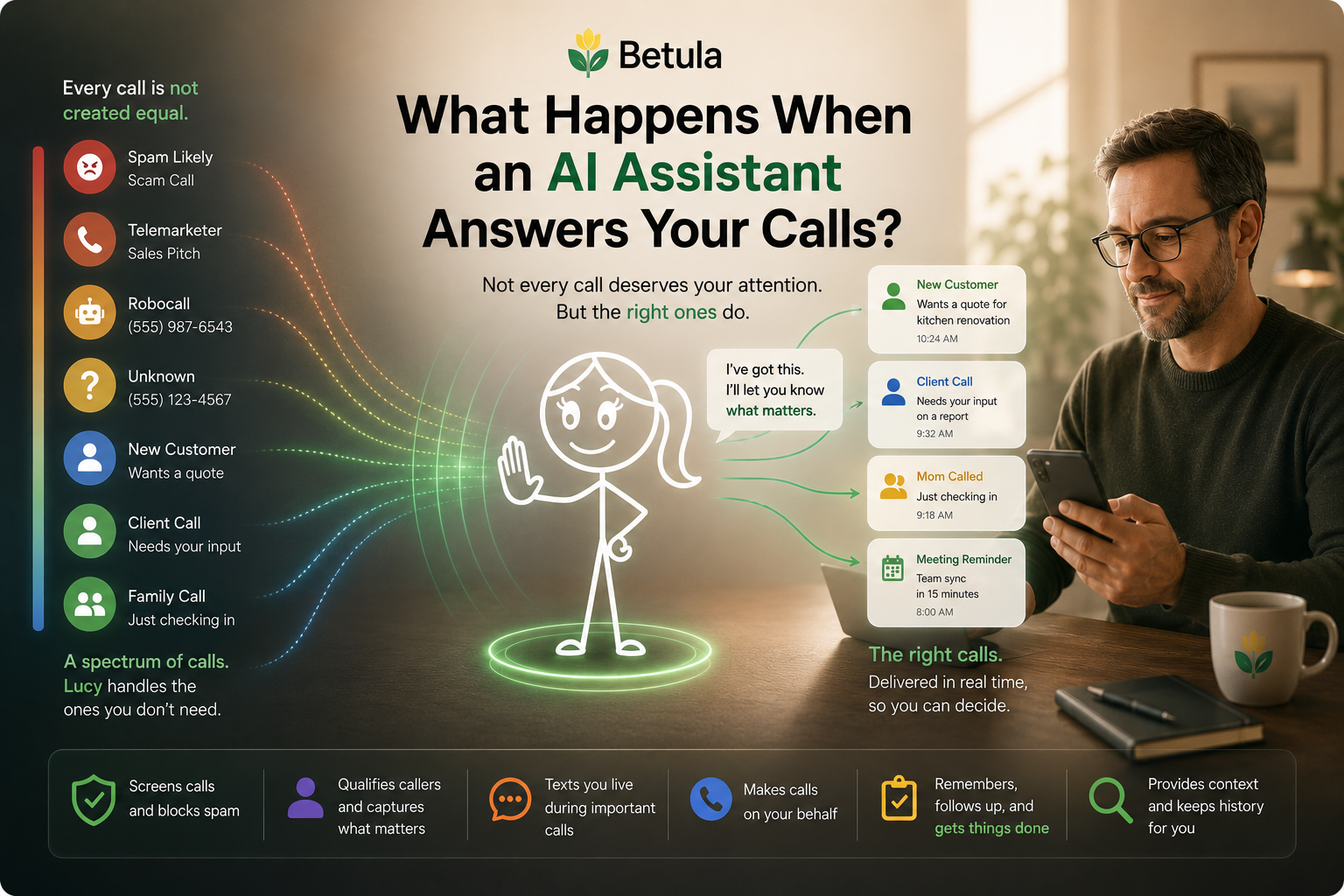
For many of them, the problem isn't answering the phone. It's deciding which calls deserve their attention.
A phone call could be a new customer.
It could be an existing customer who needs something.
It could be a colleague.
It could be a family member.
Or it could be someone trying to sell you something.
Unfortunately, they all make the phone ring exactly the same way.
So the owner has to interrupt whatever they're doing, answer the call, figure out why the person is calling, and only then discover whether the interruption was worthwhile.
That seems like an inefficient way to allocate someone's attention.
The phone call itself hasn't changed very much
This is another thing we've found ourselves thinking about.
The telephone has changed enormously. The network has changed. The device in our pocket has changed beyond recognition.
But the basic experience of receiving a phone call?
Someone calls. Your phone rings. You either answer or you don't.
If you don't, we invented voicemail.
And voicemail essentially gave the caller a box to leave something in.
The owner still has to come back, listen to it, decide what matters, delete things, and periodically deal with a mailbox that can fill up.
And when it does fill up, the problem becomes even more basic: the next caller may not be able to leave a message at all.
At that point, voicemail stops being a backup communication channel and becomes a dead end.
Caller ID and spam detection improved things. But fundamentally, the person receiving the call is still managing the communication channel.
We think AI assistants give us an opportunity to change that.
Not simply by replacing the recorded voicemail greeting with a synthetic voice, but by putting an agent into the communication channel itself.
An agent that can act on behalf of both sides of the conversation.
What if everyone called your assistant instead?
This is increasingly how we think about incoming calls at Betula.
The assistant isn't simply voicemail with an AI voice.
It is the first line of defense for the owner's attention.
When someone calls, Lucy can first find out who they are and why they're calling.
If it is a solicitation, the owner doesn't need to be interrupted.
If it is a prospective customer, the opposite is true. You don't want to accidentally filter them out simply because you don't recognize the number.
Lucy can find out what they need.
And because the assistant can know about the owner's business or professional practice, it can do more than write down a name and telephone number.
It can ask relevant qualifying questions.
A contractor might want to know what kind of project the caller has, where it is, and when they want to start.
A professional practice might want to understand what service someone is looking for.
And sometimes the caller doesn't need the owner at all. They may simply have a routine question whose answer the assistant already knows.
So the assistant isn't just taking a message.
It can be answering questions, capturing a lead, gathering the information the owner would otherwise have to gather, and deciding when the owner actually needs to become involved.
By the time the owner does become involved, the question is no longer:
"Who is calling?"
It can instead be:
"Here is who called, what they need, and what you might want to do next."
That is a very different interaction.
And, ultimately, it gives some time back to the owner.
There is a lot of space between answering and ignoring a call
This may be one of the more interesting changes an agent makes possible.
Suppose you're with a client or sitting in a meeting when an important call arrives.
Traditionally, you have two choices.
Answer it and interrupt what you're doing.
Or don't answer it and discover what it was about later.
An assistant creates possibilities in between.
Whenever appropriate, Lucy can tell you by text why the person is calling while the call is still happening.
You can glance at your phone and type:
Tell her I'll call in 20 minutes.
Lucy can tell the caller.
Or you can text a response and have Lucy speak it to the caller on your behalf.
Or perhaps you've realized that you actually do want to speak with this person.
You can ask Lucy to add you to the call.
Importantly, Lucy doesn't have to disappear when that happens. It isn't simply a call transfer. The owner can join the existing conversation, with the assistant still there and able to participate under the owner's control.
So the assistant is acting as an intermediary between two people who are communicating in different ways.
One person is talking.
The other may be sitting silently in a meeting, typing.
Lucy connects them.
That's quite different from voicemail.
Some people are beginning to use Lucy almost like a secretary
One behavior we've seen from users is particularly revealing.
Some let their assistant intercept essentially all of their non-family calls.
They handle calls from family themselves.
Everything else goes to Lucy.
Later, instead of opening a call log and working through a list of calls, they simply call the assistant and ask what happened.
Anything I need to know about?
Lucy can summarize the legitimate calls that came in and tell them about the spam that was filtered. If the owner wants to inspect a particular call, the underlying history is still there.
That interaction feels remarkably familiar.
It is how you might interact with a human secretary or office assistant.
You wouldn't normally walk into the office, inspect every telephone call your assistant answered, listen to every conversation and classify each caller yourself.
You would ask:
"Anything I need to know?"
And a good assistant would tell you.
The interface, in other words, doesn't necessarily have to be a call history screen.
The interface can be the assistant.
Family shouldn't feel like they're calling a call center
There is an obvious danger in putting an assistant in front of your calls.
You don't want your spouse, daughter, parent, close friend or someone else important to suddenly encounter a bureaucratic wall.
We've spent a few iterations on this to get it right.
If someone is already in your contacts as family or a friend, Lucy can recognize that relationship even when it is their first call to the assistant.
Their experience can therefore be quite different from that of an unknown caller.
Lucy can quickly take a message when needed. She can alert the owner while the call is happening. And as conversations accumulate, she can remember previous interactions with that person.
The goal isn't to put AI between you and the people you care about.
It is to make sure filtering everyone else doesn't make it harder for those people to reach you.
And perhaps voicemail shouldn't be a box at all
There is another benefit here that has little to do with spam or business productivity.
Traditional voicemail is storage that you have to manage.
Messages accumulate. The mailbox fills up. Old messages are deleted to make room for new ones.
And once it is full, a caller may not even be able to leave a message.
But why should a call have to work that way?
When calls are handled by an assistant, they can become part of a persistent history.
The recording can remain available. So can the transcript, summary and context around the conversation.
You can search it later.
For a business call, that means being able to return to exactly what a customer said.
But there is a much more human version of the same benefit.
A call from your mother, father, sibling, child or old friend doesn't necessarily have to disappear when the conversation ends.
Years later, the recording itself may matter more than whatever the call was originally about.
A voice we hear every day today may someday be a voice we would give almost anything to hear again.
We didn't originally think of call history primarily in those terms.
But an effectively unlimited, persistent history of calls can become something more than better voicemail.
It can become a memory of the people in our lives.
Your contact list starts taking care of itself too
There are smaller benefits that emerge once the assistant sits in the flow of incoming calls.
Someone new calls.
The assistant learns who they are.
That person can become a contact automatically.
When they call again, they aren't simply another telephone number. Lucy can recognize that they have called before and has context from previous conversations.
Over time, what would normally be a collection of anonymous numbers and disconnected voicemail messages starts becoming a history of people and interactions.
You don't have to maintain all of it manually.
But this isn't equally valuable for everyone
This is something we're also learning.
If you receive very few calls and almost none of them are spam or solicitations, having an AI assistant screen every incoming call may not dramatically change your life.
And that's fine.
Call handling is only one of the jobs Lucy can take off your plate.
You might ask her to call a doctor's office and deal with the back-and-forth of making an appointment. Or find a plumber, call around for availability and pricing, and report back. She can make a reservation, follow up with a customer, or sit on the phone dealing with routine customer service so you don't have to.
She can remind you about something you promised to do, keep track of a follow-up that might otherwise disappear, or simply remember the name of someone you met six months ago.
She can join a meeting, stay quiet until she's needed, take notes and capture the action items that come out of it.
You can talk through an idea with her and come back to it later. Or have her brief you in the morning on the things you care about.
Or it can be something as simple as keeping score while you're playing a game of cards — Lucy can be someone you turn to whenever you want to offload a small piece of thinking, remembering or keeping track.
The common thread isn't really calls, reminders, meetings or notes.
It's the small pieces of cognitive and administrative work we carry around because, until now, there hasn't been anyone else to give them to.
Lucy is an attempt to give you that someone.
But for some professionals and small-business owners, incoming calls happen to be one of the biggest pieces of that work.
Their phones ring throughout the day.
Some calls are potential business.
Some are existing customers.
Some are colleagues.
Some are solicitations.
Some are family.
And the only reliable way to know which is which has traditionally been to answer.
For these users, we're beginning to see the value of an AI assistant less as:
"Someone who answers my phone."
and more as:
"Someone who manages my calls."
That's a subtle distinction, but an important one.
Maybe we shouldn't be managing our phones anymore
For decades, we've managed incoming calls ourselves.
Caller ID helped us identify them.
Voicemail caught the ones we missed.
Spam filters tried to guess which ones weren't worth answering.
Smartphones made almost everything around the telephone dramatically smarter.
But the basic transaction remained surprisingly unchanged:
Someone calls. Your phone demands your attention. You decide what to do.
An AI assistant changes where that decision can happen.
Everyone can reach the assistant.
The assistant can understand why they're calling.
It can handle what it can.
It can bring you in when you're needed.
And it can remember what happened afterward.
For the caller, there is someone — or, more precisely, something — there to actually help rather than a recording asking them to leave a message after the beep.
For the owner, every incoming call no longer has to become an interruption.
And maybe that's the more interesting way to think about what is changing.
The phone call doesn't disappear.
You don't become less reachable.
You just don't have to personally handle everything that happens because someone decided to call you.
Some calls deserve your attention.
Some deserve a response, but not necessarily from you.
Some just need to be remembered.
And some, like the call that started this story, probably never needed your attention in the first place.
Your assistant can help figure out which is which.
Lucy's expressive, even-keeled voice is powered by Cartesia Sonic 3.5.
Thanks to ChatGPT for editorial support on this post.