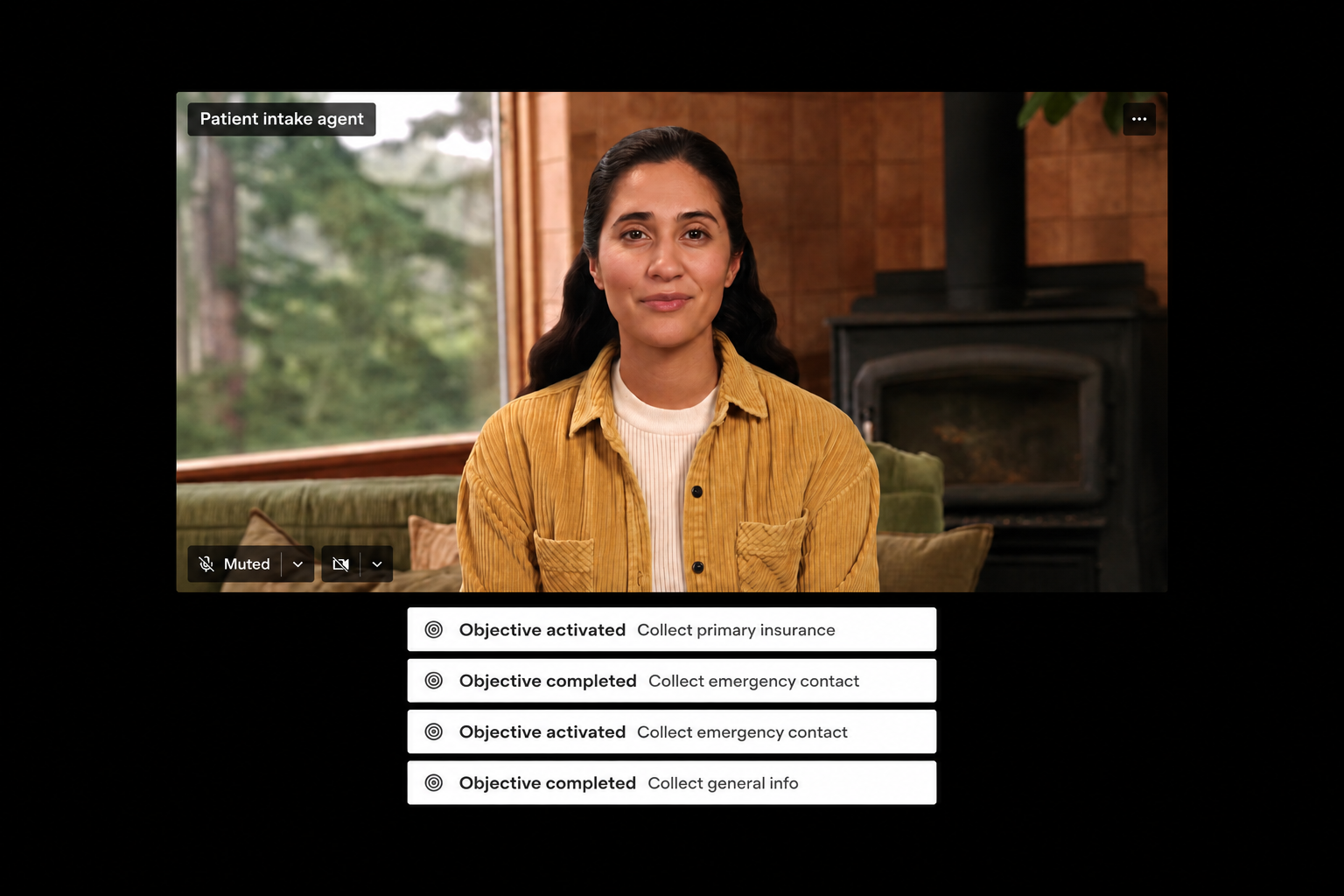
Tavus gave me early access to a new product they're about to release: PAL Maker, a no-code platform for building perception agents — agents that can see, listen, speak, and take actions driven by both what they perceive and what they're told.
We've built agents like this before. About eight months ago, we used Tavus's perception model to build one that interviewed Prof. George Church at a healthcare summit; a variant of it was demonstrated at Davos five months ago. Those were built by writing code. So I was curious to see whether I could build one of the same kind — a patient intake agent — without writing any.
The use cases for perception agents are broad. Anything from joining a meeting and taking part in it, to healthcare scenarios like patient intake, benefits from an agent that can see the person and the environment, not just hear them.
Summary
This is a very promising first release. I built an intake agent without writing a line of code in under 30 minutes. All I had to do was upload a publicly available patient intake form, and iterate with the guiding agent to shape the behavior prompts. Essentially, I built an agent by talking to an agent — the same pattern we shipped for voice agents at Betula a year ago, and one that clearly works for building perception agents too.
You can try what I built here. If several people are on it at once you may hit the concurrent-user limit — this is a preview, after all.
The agent-building interface
Well done. I could move between build, test, and deploy quickly, and the guiding agent stays with you through all three phases, ready to help. The whole loop feels tight — you tweak a prompt, test it in the same view, deploy, come back and refine.
Latency
The agent interaction feels smooth, which is impressive given what's happening under the hood. A perception agent's pipeline is very similar to a voice agent's, but with an added perception model over the video stream. So the full loop is: turn detection, STT, perception model (which itself can call tools, much like an LLM), LLM, TTS. Keeping that end-to-end under a conversational latency budget is real engineering.
Turn detection
Turn detection is generally smooth, but I hit one recurring rough edge worth calling out. Occasionally the agent seems not to register that I've spoken — it keeps waiting, as if I haven't finished — and I end up repeating myself.
A simple fix would be to show the user's transcribed speech immediately below the agent as they speak, the way most modern voice UIs do. That gives the user a visual cue that the input has been received and is being processed, and stops the "did it hear me?" reflex to repeat. Small change, big UX impact for anything conversational.
Tool calls
Hooking up tool calls via webhooks is straightforward. This is the mechanism that turns a perception agent from a conversational demo into something that can actually take action — book an appointment, submit a form, update a record — so it's an important surface, and PAL Maker's version of it is clean.
Conversation context and knowledge base
For most agents where complexity isn't extreme, you can probably build a production-quality one entirely within PAL Maker. Memory persists across sessions, and you can upload documents as a knowledge base. In my case, I uploaded the patient intake form, gave a few instructions, and the agent handled the rest — asking the questions on the form, capturing answers, and moving through the flow sensibly.
Conversation flow graph
The guiding agent inferred a fork in the conversation flow directly from the intake form I uploaded. I didn't push this myself, but it suggests that most simple conversation flows can be built just by talking to the guiding agent about what you want. That's a genuinely useful capability — flow graphs are usually one of the more tedious parts of building conversational systems.
Deployment
Deployment is easy: share a link, embed the agent on a site, or have it join a Google Meet. The friction is genuinely low, which matters — a lot of no-code platforms make building easy but shipping hard. PAL Maker seems to have thought about both.
Closing thoughts
PAL Maker is a promising first release. For teams that need perception agents — meeting participants, intake assistants, in-store guides, whatever else the pattern unlocks — this is the fastest path from idea to deployed agent I've seen. There are rough edges (the turn-detection cue being the main one for me), but they're the kind of things a preview is for.
If you're building in this space, it's worth an evaluation.
Thanks to Claude for editorial support on this post.